

Legacy
Public Art Made after 1989
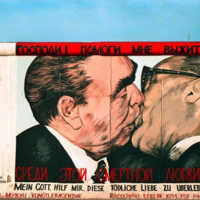
Public art made in the former GDR after its collapse also references GDR history and artistic styles. For example, Dmitri Vrubel's mural, My God, Help Me to Survive This Deadly Love, is based on a famous photograph depicting Honecker and Brezhnev kissing taken by Régis Bossu in East Berlin on October 7, 1979. Part of Berlin's East Side Gallery, it is painted on the East German side of the Berlin Wall as a reclamation of space. The title references their oppressive regime and East Germans killed at the wall while trying to escape it.
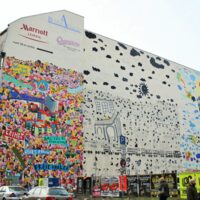
In addition, Michael Fischer's mural, The Peaceful Revolution, references the Peaceful Revolution in Leipzig on October 9, 1989. On this day during the Peaceful Revolution, 70,000 people protested without the violent backlash expected from GDR authorities. The protesters depicted in the mural hold up signs with the same slogans seen at the protests. Fischer painted the mural to commemorate the Peaceful Revolution's 20th anniversary. Furthermore, Fischer's artistic style is influenced by socialist realism.
GDR Public Art in the 21st Century
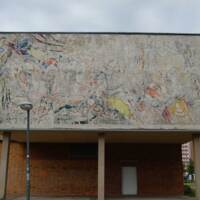
Many pieces of public art from the GDR have been destroyed along with their buildings. This is especially true of public art on GDR government buildings. Others, like Of Human Responsibility by Ronald Paris, are disappearing through benign neglect. According to the Wüstenrot Foundation, as of 2019, only approximately 60% of East Germany’s public works of art have survived, and most need restoration and preservation.
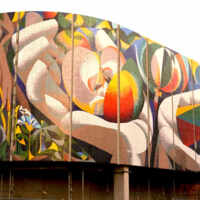
However, public opinion regarding the GDR’s cultural heritage is changing now that the nation’s collapse was three decades ago. For example, many extant public artworks have been designated cultural monuments in the 21st century. Finally, the Wüstenrot Foundation, located in former West Germany, has funded the restoration of public art from the GDR, including two mosaics by Josep Renau.