Josep Renau
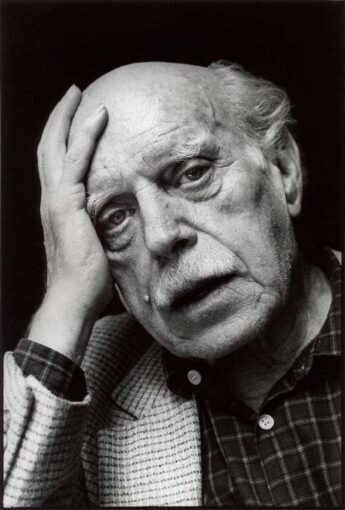
Josep Renau Berenguer made some of the GDR’s most famous mosaics, but he was born in Valencia, Spain, in 1907. From 1919 to 1925, Renau studied at the San Carlos Art Academy in Valencia. After completing his studies, he worked as a graphic designer. In 1932, Renau married artist Manuela Ballester, and the couple had five children together. He taught art at the University of Valencia from 1932 to 1939.
Renau evacuated art from the Prado Museum to Valencia before the city was bombed during the Siege of Madrid. He was in charge of the Spanish Pavilion at the World Exposition in 1937 in Paris. He exhibited his photomontages and commissioned Pablo Picasso’s Guernica. Renau was a communist and opposed General Franco. As a result, he was forced to flee Spain in 1939 to avoid a death sentence. He eventually ended up in Mexico later that year. After arriving in Mexico, he made film posters, photomontages, and murals, including collaborations with David Alfaro Siqueiros.
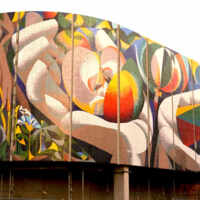
In 1958, he left Mexico for the GDR. During his time there, he made mural mosaics that can still be seen in Halle (Saale), Erfuhrt, and Halle-Neustadt. The former two murals were removed, restored and remounted in recent years. The restoration of Renau’s mural in Halle-Neustadt was announced in 2022.
Renau’s exile ended in 1976, and he returned to Spain to work. However, when his health started to decline in 1982, he returned to the GDR and died in a hospital in East Berlin.
Art by Josep Renau