

History
Formation of the GDR
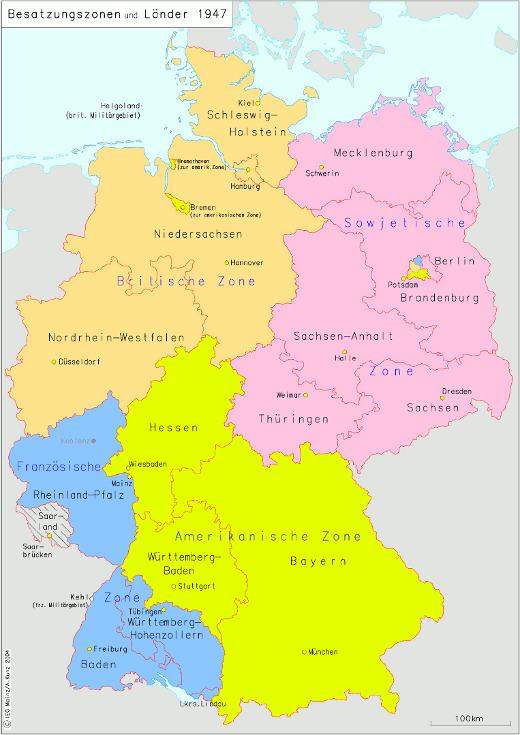
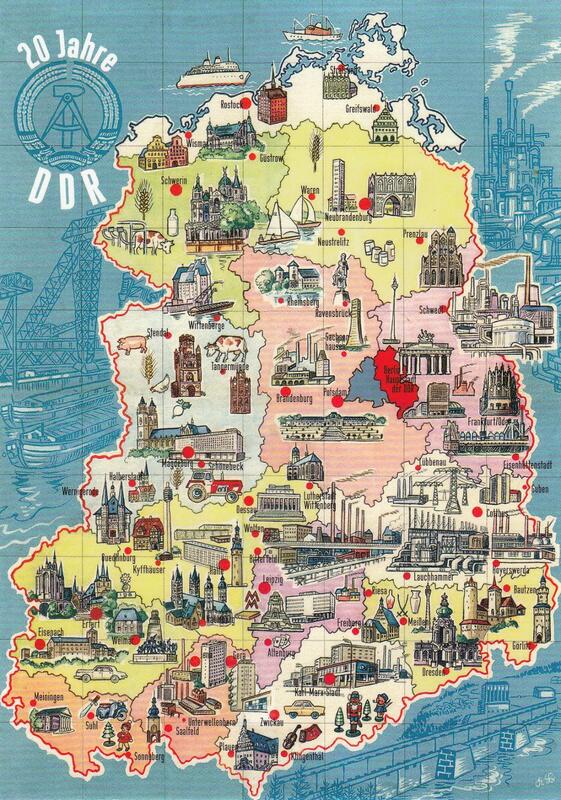
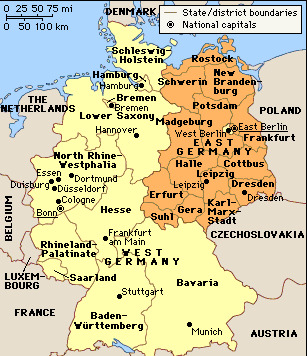
Following the defeat of the Nazis in the spring of 1945, Germany was divided into occupation zones. German territory occupied by Poland became part of Poland. The rest of East Prussia became part of the USSR. What we know today as Germany was divided into the American, British, French, and Soviet occupation zones, and Berlin was divided amongst and occupied by these four nations. The Soviet occupation zone included Brandenburg, Mecklenburg-Vorpommern, Sachsen, Sachsen-Anhalt, Thüringen, and East Berlin. On May 23, 1949, the American, British and French occupation zones combined into the Federal Republic of Germany (FRG, BRD, or West Germany). The Soviet zone became the German Democratic Republic (GDR, DDR, or East Germany) on October 7, 1949.
The SED
In April 1946, in the Soviet zone, the Communist and Socialist parties merged to form the Socialist Unity Party of Germany (SED). The SED was the GDR’s ruling political party for all 41 years of the nation’s existence. After 1950, the First Secretary of the SED was the highest leader of the GDR. Two long-serving and influential leaders held the position, Walter Ulbricht from 1950 to 1971 and Erich Honecker from 1971 to 1989. After assuming office in 1950, Ulbricht established the Staatssicherheitsdienst (Stasi), a secret police force.
Reparations
The economy and living conditions in the Soviet zone suffered due to crops, goods, resources, machinery, and monetary and material wealth extracted by the Soviet Union as reparations for World War II. According to official data from the Soviet government, the Soviet Union received $2.68 billion in reparations from Soviet-occupied Germany between August 2, 1945, and January 1, 1948.
Emigration
Poverty forced Germans to flee to the West for better economic conditions and opportunities, an act called Republikflucht by GDR authorities. As a result, 3,429,042 people emigrated from the Soviet occupation zone and the GDR between 1945 and the construction of the Berlin Wall in 1961. From 1955, GDR authorities stigmatized Republikflucht to discourage emigration. After the Berlin Wall’s construction began, Republikflucht became criminalized in the GDR. As a result of the treacherous, fortified border wall, the number of emigrants declined. Still, many risked their lives hoping for a better future in the West.
The Berlin Wall
The Berlin Wall encircled West Berlin, cutting it off from East Berlin and the GDR. The Wall had guard towers staffed by armed guards who received incentives to shoot to kill. In addition, the area between the East and West German sides of the concrete border, called the “death strip,” was fortified with anti-vehicle trenches and beds of nails. GDR propaganda portrayed the Wall as protecting its citizens from infiltration by the fascist West. Its official name in the GDR was the Anti-Fascist Protection Wall. However, citizens noticed that all the guns pointed inward. The Berlin Wall’s true purpose was to stop East Germans from fleeing to West Germany. After the Berlin Wall’s construction began, Republikflucht became criminalized in the GDR and travel outside the Soviet Bloc was heavily restricted. As a result of the dangers of crossing the wall, the number of emigrants declined. Still, many risked their lives hoping for a better future in the West.
“Over 100,000 citizens of the GDR tried to escape across the inner-German border or the Berlin Wall between 1961 and 1988. More than 600 of them were shot and killed by GDR border guards or died in other ways during their escape attempts. They drowned, suffered fatal accidents, or killed themselves when they were caught. At the Berlin Wall alone, at least 140 people were killed or died in other ways directly connected to the GDR border regime between 1961 and 1989, including 100 people who were shot, accidentally killed, or killed themselves when they were caught trying to make it over the Wall; 30 people from both East and West who were not trying to flee but were shot or died in an accident; 8 GDR border guards who were killed on duty either by deserters, fellow border guards, a fugitive, someone helping fugitives, or a West Berlin police officer; and at least 251 travelers from East and West who died before, during, or after inspections at checkpoints in Berlin. These figures do not include the people who died of grief and despair over the Wall’s impact on their personal lives.” (from Berlin.de, the official website of the State of Berlin)
The New GDR Constitution
In April 1968, Ulbricht instituted a new constitution that more accurately reflected the realities of life in the GDR. The original 1949 constitution mentioned the people and was liberal and utopian in comparison. The new constitution reflected the SED’s absolute power, professed Communist values, and emphasized workers. In 1971, Leonid Brezhnev, the leader of the Soviet Union, had Ulbricht removed from leadership. Erich Honecker replaced him. Honecker repealed the policy that considered the GDR the only legitimate German state. The Basic Treaty established diplomatic relations between East and West Germany on December 21, 1972. Honecker amended the new constitution in 1974 to remove references to Germany and highlight friendship with the Soviet Union.
1989, the Beginning of the End
On May 7, 1989, citizens were outraged when SED candidates won 98.85% of the vote in rigged local elections. Before the election, activists circulated fliers criticizing Honecker and the SED and urged people to boycott them. However, voting in the election was practically required because if people did not vote, the Stasi showed up to force their participation. Thus, boycotting the election was risky, but some people did so that year. Others watched the vote count. In addition, 20% voted against the SED’s candidates, so their claim that 98.95% of citizens voted for them proved that the elections were rigged. A small group of citizens protested the election results on the streets of Leipzig for two days. The Stasi arrested over 100 people, but they could not suppress people’s rage and frustration much longer.
In April 1989, the Hungarian government turned off the electricity on the fence along its border with Austria. Then, on June 27, 1989, the Hungarian and Austrian governments cut the fence open in an official ceremony. This act inspired thousands of East Germans to cross from Czechoslovakia into Hungary. They stayed there or claimed asylum in embassies but did not usually attempt to cross the border into Austria. However, on August 19, 1989, over 600 East Germans abandoned their cars and crossed the Hungarian border into Austria during the Pan-European Picnic, a political demonstration coordinated by Austria and Hungary. On September 10, 1989, the Hungarian government ceased restricting travel between Austria and Hungary. As a result, thousands of East Germans took advantage of the opportunity to escape to the West.
The Peaceful Revolution
Weekly demonstrations against Honecker's regime began in Leipzig on September 25, 1989. On October 2, 1989, 10,000 people showed up to protest. After that, more people joined the weekly demonstrations. However, Honecker ignored the protestors' demands and celebrated the 40th anniversary of the GDR’s founding on October 7, 1989, with Soviet Union’s leader Mikhail Gorbachev in attendance. Later that night, the first mass demonstration against the SED occurred in East Berlin. In addition, 70,000 protestors gathered in Leipzig on October 9, 1989, the first Monday after the 40th anniversary of the GDR. As a result, Gorbachev fired Honecker on October 18, 1989. However, he replaced him with Egon Krenz, who was equally unpopular. As a result, the demonstrations across the GDR and the mass exodus into Hungary and Czechoslovakia continued. The number of protestors eventually grew to 300,000. The protests became known as the Peaceful Revolution.
The Fall of the Berlin Wall and Reunification
Krenz’s government drafted new policies allowing travel between East and West Germany to placate East Germans and prevent a massive uprising. Krenz handed the new regulations and a press release to the SED spokesperson in East Berlin, Günter Schabowski, right before he left for a press conference without further instructions. Schabowski read the press release at the press conference. Then, a reporter asked him when the new policy would begin. He erroneously answered, “Immediately,” and clarified that crossing the Wall into West Berlin was included. West German TV stations reported on the press conference and announced that evening that the border was open. East Germans saw their broadcasts and swarmed the checkpoints at the Berlin Wall. The border guards were unprepared, overwhelmed and outnumbered. The crowds forced the guards to open the checkpoints because they could not control or contain the situation. East Germans streamed through into West Germany. West Germans greeted them with open arms and handed them money, flowers, sparkling wine, and delicacies that were unavailable in the GDR, like chocolate and tropical fruit. The crowd destroyed sections of the Berlin Wall. On December 22, 1989, the Brandenberg Gate opened, coinciding with new policies allowing West Germans into East Germany.
The East German government began officially dismantling the Berlin Wall in 1990, but the removal of the Wall was not complete until 1994. It was almost completely destroyed, with only three significant segments remaining at the Topography of Terror, the East Side Gallery and a memorial at Bernauer Straße. On March 18, 1990, the GDR held its first free government elections. On July 1, 1990, the GDR abolished the Ostmark and adopted the Deutsche Mark. Then, East and West Germany signed the Unification Treaty on August 31, 1990. Finally, East Germany and West Germany reunified on October 3, 1990.